Showing posts with label Overcoming Racism. Show all posts

Monday, September 4, 2017

Blinded By Our Own Racism

My son and I spent a week on a bus tour of Central and Eastern Europe last month. It was truly a remarkable experience and helped us learn a lot about history and also a lot about the European perspective on life.

One thing we learned was that liberal Europeans tend to think of America as still being a racist nation while thinking of themselves as more enlightened and accepting of various races. Europeans like to point out their acceptance of immigrants during the Syrian crisis as one proof of their enlightened views. Sounds cut and dry, and easy to understand. That is, until you bring up Gypsies. Gypsies, or more properly called “Roma,” are spread across Europe. They are especially common in Eastern Europe. Though Europeans pride themselves on having outgrown racism, we heard over and over again on our trip how we need to be cautious around the Gypsies. They were described to us as “lazy and dishonest” and also frequently called “pickpockets and thieves.” Europeans do not consider this to be a racist statement, they just consider it to be factual because “everyone knows Gypsies are bad.” WOW! All my American emotional triggers were going off! And rightly so. To condemn an entire category of people just because a handful might be pickpockets is the very definition of racism.

But the point of my post is not to argue about crime statistics for Gypsies in Europe. The point of my post is to illustrate how cultural blind spots exist in every culture.  For many Europeans, being racist toward gypsies is an “acceptable” viewpoint even though Europeans work hard not to be racist. Though it is clearly a racist opinion, they cannot see their own hypocrisy on the issue. They condemn Americans for our racist views (and perhaps rightly so!) but miss seeing their own.

I think this is a great teaching moment for anyone who will take time to reflect on it. I think all of us, Americans and Europeans, regardless of our race, have certain cultural blind spots in how we view others. We tend to lump large groups together and make broad negative statements about them. This is always a bad idea. Yet most of us do it. We may think we have moved beyond it, but others see our inconsistency far more than we can see it in ourselves. This is something we must continue to work on as individuals and as a nation. But it is worth the effort and worth the struggle. Imagine how it must be for a Gypsy child walking down the street watching everyone grab their pocket books in fear that the child will steal their money. That is no way for a child to grow up. Replace the word “gypsy” for any other group, and we begin to see how dangerous this viewpoint is.

We may not be nearly as enlightened as we think we are. But thankfully, we can reflect on this reality and grow in our worldview concerning those who are different from us. This is something we can, and must, do.

-------------

Dr. Terry W. Dorsett has been a pastor, church planter, denominational leader and author in New England for more than 20 years. He is a happy husband, a proud father and adoring grandfather. He is a cancer survivor and believes that God works powerfully through times of suffering. He writes extensively and you can find all of his books at:

Saturday, November 19, 2016

Racism: Alive and Well Around the World

Racism. It is an ugly word. It is a hard thing to overcome. One challenge when talking about racism is that people’s defenses immediately go up and they struggle to hear what the other side is really saying.

A few years ago I witnessed a terrible experience of racism. I was literally trapped in the middle of it. It was a painful experience. My wife and I were on a plane headed to Israel. Regretfully we were not seated together. I was in a middle seat between an ultra-Orthodox Jewish man and an Arab businessman. The Jewish man engaged me in conversation and asked if I was Jewish and if I spoke Hebrew. I told him I was Christian and only knew English. Undeterred, the Jewish man asked all about where I lived, my family, and why I was visiting Israel. The other man made lots of snorts and mumblings at the various things the Jewish man had to say and he became more and more agitated. He put his jacket over armrest so that it laid across my lap. He leaned over my armrest into my space mumbling all about how bad Jews were. He stretched one leg out so that it was in front of me most of the trip. I tried to engage him in conversation the same way that I did the Jewish man, but he simply turned away. His sense of frustration grew with each hour of the plane ride, as did his constant efforts to make the trip uncomfortable for everyone in the row. Thinking that such displays of racism were only for wild fringe elements of groups like ISIS, I was disappointed to see it from a well-dressed businessman in public.

The situation changed once we got off the plane and we were in “Jewish territory.” We were met by our Jewish guide and he led us around the nation for the next five days. At every opportunity he bashed the Arabs and told us how much they had damaged his nation. At one point his racial prejudice became so great that several members of the group could no longer remain silent and asked him to refrain from making racist comments about Arabs. He managed to hold them back for the afternoon, but the next day he was right back at his anti-Arab conversation. He did not even seem to be aware of how racist he was. It was too ingrained within him.

Neither “side” had the corner on racism. Both sides clearly hated each other. And that hatred was so ingrained in both sides that neither could see their own part in it. It was sad to see how common racism is in the Promised Land, the land where Christ walked, lived, preached, died and rose again to free us from the chains of such sin. As I pray for the peace of Jerusalem, I pray for those who live in that land to see each other as people created in the image of God and to treat each other accordingly. In light of all that has been happening in our own nation the last few months, I have also been praying for America as well. Though we have made great progress, America clearly still has a very long way to go. Join me in asking God to help each of us eliminate racism both in our lives and from across our land.

Lord, fill us with love for each other and help us see beyond our ethnicity to find the special creation we all are in the eyes of God. Lord, bring peace to Jerusalem and bring peace to America. Let it begin in me. Amen.

----------------
You can read about Terry’s entire trip to Israel in a devotional guide he wrote called:  Touching the Footprints of Jesus. 


Saturday, September 24, 2016

Overcoming Racism

Galatians 3:28 (ESV) - There is neither Jew nor Greek, there is neither slave nor free, there is no male and female, for you are all one in Christ Jesus.


A few months ago my son-in-law and I, who are both white, were shopping in a neighborhood where most residents were people of color. After making our purchases we headed to the door to leave and noticed they had a "checker" going through bags as each person left the store, presumably to make sure no one had stolen any items. That is not that uncommon so we got in line to have our bags checked. When the checker saw us, he waved us through without looking at our bags. While waving us through, he continued carefully going through the bags of the other people in line, all of whom were people of color. Though we cannot know for sure why he waved us through but made everyone else wait in line, the only conclusion we could think of was because we were white. The bag checker apparently thought white people could not possibly steal stuff from stores but people of color might. So their bags needed checked but ours did not. 

Since that experience I have become more aware of this kind of stuff happening. I cannot imagine the frustration, indeed the anger, that people of color must feel when they are degraded publicly like that in stores that they shop from regularly. I cannot imagine the fear moms of color of have when their sons walk to the grocery store. I cannot imagine the pent up angry that rests just under the surface of those who experience discrimination again and again and again so many years after the Civil Rights era was supposed to have solved all of this.

I don't know how to fix it, but I know that pointing it out so people become aware of it is one step. In retrospect, I should have gone back to that store and insisted that my bag be checked. I did later send an email to the store manager, though I never got a response back. Only by speaking up can we help people see how wrong this kind of thing is.

I also think we can address this issue by not falling prey to subtle racism in our own lives in the way we interact with people of color on a day to day basis. Though I'm not a perfect example to follow, one thing I try to do is when I see a person of color, especially a young man, is to look them in the eye and speak to them. Even if all I do is say hello as I pass them on the street, it is my way of saying "I see you and I think you are important enough to notice." I want him to know there is at least one white man out there in a position of influence who saw him as an equal. It may not change the world, but perhaps for that one young man, it makes him walk a little prouder that day. And if enough of us do it, maybe all those young men will realize they do not need to be pressed into a mold of someone else's making, they can become whatever the Lord leads them to be.

Lord, help us see past the color of our skin and demonstrate Your love for all people. Amen.


----------------

Dr. Terry W. Dorsett has been a pastor, church planter, denominational leader and author in New England for more than 20 years. He is a happy husband, a proud father and adoring grandfather. He is a cancer survivor and believes that God works powerfully through times of suffering. He writes extensively and you can find all of his books at:

Tuesday, June 14, 2016

Preschoolers Will Help the Church Finally End Racism!

Psalm 8:2 - From the mouths of children and nursing babies you have ordained praise on account of your adversaries, so that you might put an end to the vindictive enemy.

My granddaughter recently celebrated her 2nd birthday. Her parents, who are ministers, invited all the children from church to the party. Ten children came. It was a lot of fun watching them play games, eat cupcakes and enjoy being together. About an hour into the party it suddenly dawned on me that of the ten children who were present, 4 were African American, 3 were Asian, and 3 were Anglo. I doubt the children noticed. In fact, I'm sure the children did not notice because the children gathered there did not see each other as black or white or Asian, they were just friends from church celebrating a birthday. My granddaughter and her peers are growing up in world where the color of one's skin is no longer the divider between who your friends can be or where you can worship. 

Lest you think that my granddaughter is some rare exception, it is important to point out that America's preschoolers are growing up in a vastly more racially diverse atmosphere than their parents or grandparents. If current trends continue, by 2020, only four years from now, there will no longer be any single racial group that will make up more than 50% of the U.S. population under the age of 18. With the youngest ages as the most diverse in American history.

This is good news for the church, and for the nation! Though we have made great strides in America in the last 50 years in the area of race relations, the Sunday morning hour still tends to be the most segregated hour of the week. Though it is most likely unintentional, it is still a reflection of what is in our hearts, which is that in our most intimate moments, we prefer to gather with other people who look, act and feel like us. However unintentional, when we gather to worship only with others who look just like us, we miss something valuable that we can learn from the larger body of Christ.


Lord, help us follow the example of our children and learn these valuable lessons about friends and church. Amen.

-------------------


Dr. Terry W. Dorsett has been a pastor, church planter, denominational leader and author in New England for more than 20 years. He is a happy husband, a proud father and adoring grandfather. He is a cancer survivor and believes that God works powerfully through times of suffering. He has written a number of books, including one about how the spirit of offense is destroying our current society. You can find all of his books at:

Tuesday, March 1, 2016

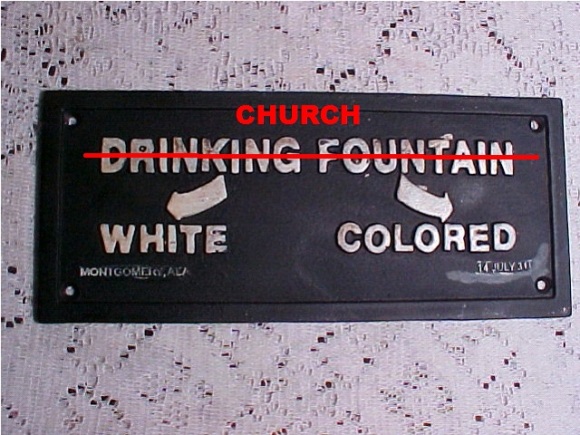
SEPARATION, EQUALITY, AND THE CHURCH - Guest post by Itamar Elizalde

I’ve often mentioned that I was born in the wrong decade. I absolutely love studying and reading about the civil rights’ movement of the 1950’s and 1960’s. I’ve pictured myself at sit-ins and marches, singing in churches awaiting a speech by Rev. Dr. King. I am fascinated with the non-violent movement, proud of those within the Church who stepped up against injustice and deeply saddened by the forces of people who used the Christian faith to justify their own comforts and a sinful status quo.
The emotions I feel about our history are perhaps what fuel my shock about our present complacency both culturally (in our wider secular context) and within the Church. Segregation is more prevalent today than it was right before the civil rights movement. I lead a workshop of high school freshmen and they could very well attest. Their school and neighborhood are “dominated” by Hispanics while the next town over “is all white people”. They are also quick to respond that it’s different today than it was in Rosa Parks’ era of civil disobedience. When asked why, students respond that it is because it is their choice. They choose to stay in their particular town and not move to the next town over. Nobody is forced. There are no signs to determine which race or ethnicity can live where.

It’s our choice. Equality is now the law. Separation is our choice. My response was, “so we’re essentially separate… but equal”.

The kids could recognize the phrase that carries a heavy connotation to anyone who has studied the civil rights movement, but it rings true today. Here are some thoughts on our current complacency that justifies separation and blinds us to our responsibility…

Separation limits our choices. I love being Puerto Rican. I really do. We’re an odd bunch and I love it. But there are some things I do not like about my culture. It’s prideful and stupid of me to accept things of my culture that are ineffective, irrelevant or, worse, damaging (although this happens all the time). There are things about the Asian culture (as a random example) that I love and incorporate in my life. Things that are solid, sound, and biblical. If I choose to separate myself, I limit my exposure—securing ignorance, delaying growth, stunting progress and exposingdisobedience. Freedom is based on a freedom to choose. Just as sin enslaves, thus giving the illusion of freedom but forcing us to live under its consequences, the sin of intentional separation gives the illusion of freedom but limits rather than liberates.
Separation erodes our understanding of one another.  I confess: I love shortcuts. I like spending less time to get to exactly where I need to go. Stereotypes often seem like shortcuts to genuine community. I’m guilty of this one all the time. I don’t need to ask her, I know she’ll say no because she’s like this… It leads me to believe that I know others when I really don’t. This essentially deceives us into believing we’ve taken a shortcut when it’s only deviated us from genuine community. This has only gotten worse through the polarization of our politics. There is no need to have a conversation with anyone who votes Democratic or Republican because, well, we already know what they will say. People become static; a caricature, even.
I don’t want to go into the dangers of caricatures, stereotypes, segregation and hate but instead speak with the Church. I do see a direct link between willing separation and facilitating stereotypes, even subtle ones. And while I like groups with similar interests in background because of the support they can often provide, I’m bothered when these are more common than (or even replace) our explicit efforts of integration.

So what, then, shall we do? We, the Church, need to lead efforts of explicit integration by incorporating diversity not only in policies but in preaching, teaching, mission statements, and outreach. Encourage conversation with like and unlike-minded people. Remind each other that Jesus ate with known liberal types and sat down with conservative judges and was willing to compromise his reputation with some without compromising his character.

We often watch television, look at our bi-racial president and believe Jim Crow is dead when he’s quietly making a living in our churches, social circles and implicit belief systems. Intentional separation, like any other sin, is to be fought with repentance and empowered by grace. We shouldn’t be okay with separate fellowships based solely on race. We shouldn’t be okay with distinguishing our worship styles based on ethnicity. And we shouldn’t be okay with not addressing these issues simply because we want to avoid difficult theological conversations that expose our desperate need for grace.

-----------------
Itamar lives in Central Mass and is a campus minister in the Worcester area. She describers herself as a petite Puerto Rican with not so petite thoughts. This post, which was used with her permission, originally appeared on her blog, which can be read at:
https://itamah.wordpress.com/2011/05/21/separation-equality-and-the-church/

Thursday, February 18, 2016

Generous Racism

Acts 10:34-35 - So Peter opened his mouth and said: Truly I understand that God shows no partiality, in every nation anyone who fears him and does what is right is acceptable to him.


My friend Thomas* is a well-educated professional. He is a recognized leader in his field. He is a published author. He has a lovely wife, who is also a well-educated professional, and two lovely children. He is a picture of the perfect American family and would be considered successful by any reasonable standard. He also happens to be African American.

When Thomas felt a call to ministry, God gave him a heart to help people from urban areas find ways to create a better life for themselves in self-sustainable ways. He has some very innovative ideas for how to fuse business and ministry models so that ministry in an urban setting can have all the resources needed to support a holistic approach. With his education and experience, Thomas could easily serve an affluent suburban congregation. But he has chosen to minister in an urban context, which means that many of those he serves have fewer financial resources, and many are from various minority groups common to urban areas.

He and I were talking a couple of months ago about how to find capital investors who could help him get his unique business/ministry model off the ground. In the midst of the conversation he said something that has reverberated in my mind over and over again. He said, “Sometimes affluent people see minorities as their charity cases” and went on to explain that many affluent people only want to fund things that make them “feel good about themselves instead of actually solving the problem.” For example, affluent people are happy to spend money buying several bags of groceries for the local food bank, but few would buy their weekly groceries from a small minority owned local market. One makes the donor feel good about themselves but only addresses the symptom. The other would help create a successful business man who would then be able to provide jobs in the community so fewer people needed the services of a food bank but it is not as emotionally exciting. Many affluent people are willing to volunteer at a soup kitchen every month, but far fewer are willing to be a mentor to a disadvantaged young person, helping he/she get through high school and into a good college so he/she secure a job and never have to depend a soap kitchen for a meal. Both volunteer efforts are worthwhile, but one perpetuates dependence and the other solves a problem.

When those of us with greater resources view minorities as our charity cases, we are unintentionally displaying generous racism. Though we may be proud of ourselves for our generosity, it is still a form of racism if the only thing we support are “feel good” projects. When we only want to donate or volunteer in ways that set us up as superior to those of other races or of other economic levels, it might make us feel good but it also keeps people from reaching their full potential. This generous racism is still racism, and should not be encouraged.

Does this mean we should stop buying groceries for food banks or volunteering at soup kitchens? No. But we should view those efforts as one part of a bigger picture of how we address the challenges of urban dwellers, a significant number of which happen to be from various minority groups. We must look for ways that actually solve problems and that must include viewing minorities as fully capable of succeeding in life, and not as just our charity cases.

And if you happen to be a venture capitalist that wants to get in on the something cool in the greater Hartford, CT, area, contact me and I will put you in touch with Thomas. You will be impressed!


*Name changed for privacy reasons

-------------------------------------------

Dr. Terry W. Dorsett has been a pastor, church planter, denominational leader and author in New England for more than 20 years. He is a happy husband, proud father and adoring grandfather. He is a cancer survivor and believes that God works powerfully through times of suffering. He has written a book about the spirit of offense that prevails in our current society. You can find all of his books at:


Monday, February 9, 2015

Overcoming the Holy Huddle – Regaining an Outward Focus

Most churches in America are small, with less than 200 in worship. For generations small churches have effectively cared for the spiritual needs of our families and our communities. Small churches helped focus on what was really important and our communities were stronger because of them. In the past 25 years our culture has changed and suddenly small churches are no longer having the impact they once had. As communities have changed, many small churches have responded by withdrawing from the community and “hiding” in the church building. Though being part of a “holy huddle” might make us feel safer, the community desperately needs the life changing power of the Gospel. When we withdraw from the community because we do not know how to deal with change, it hurts both the church and the community.

In the past, many communities had certain common characteristics. Everyone knew everyone and there were lots of connections through school, church, and community organizations. Many people were related by blood or marriage to a significant portion of the local population. Racial groups often stayed together in certain neighborhoods because it made them feel more comfortable.  Community members knew the unofficial rules of how to get things done, which had a lot to do with who one knew more than paperwork and policies. People were more respectful of religion in general, though not everyone went to church on a regular basis. People spent most of their time with those who had similar  educational levels and economic realities.

But most communities have changed. Though the old stereotypes can still be found, they are not as prominent as they once were. With the advent of technology, people are constantly exposed to other ways of thinking and no longer just accept that what “used to be” is the way things “should be.”

How Does This Impact Small Churches?
•      The influx of new ideas is rapidly transforming the mindset in most communities into a more postmodern way of thinking. Postmodernism is the idea that individuals have both the intelligence and the right to decide for themselves what truth is without any objective standards. Because churches typically base truth on the Bible, it often puts churches in conflict with how postmodern people think.
•      Postmoderns decide what truth is based on individual experiences and relationships. They do not recognize absolute truth. However, many postmodern people are actually interested in learning about spirituality, they just want to do it on their own terms. To learn more about how to reach postmodern people, consider reading, Mission Possible: Reaching the Next Generation through the Small Church.
•      Though we should not give up our biblical values to reach postmoderns, we may have to change some of our man-made traditions in order to break out of our holy huddle. Many churches will struggle with giving up their man-made traditions, but for the sake of the Kingdom, we must. The challenge will be in praying through what is a man-made tradition that we can let go of and what is a biblical mandate which we must retain no matter what.

Five suggestions for How Small Churches Break Out of the Holy Huddle and Impact Changing Communities:
1.     Embrace technology
2.     Embrace bivocationalism and lay ministry
3.     Embrace racial diversity
4.     Use church buildings for more than worship
5.     Get outside the walls of the church into the community

Embrace technology
•      Postmodern people are more “virtual” than ever before. That means they often socialize via technology more than in person. Churches must discover how to use Facebook, Twitter, Instagram, text messaging, blogs, websites and other technological innovations. People no longer look in the “yellow pages.” Many people are less open to a home visit and prefer to connect through technology.
•      Embrace technology in public worship services without losing the sacred aspect of church. Merging technology with ancient liturgy appeals to postmoderns, because they like to “experience” different things. This is particularly effective when we explain the meaning behind the rituals. Therefore, invest in a projector and screen and use them when we quote the Lord’s Prayer or sing traditional hymns.

Embrace bivocationalism and lay ministry
•      Funding for small churches is going to be diminished in the future for a variety of reasons. Therefore, we must accept the reality of bivocational ministry and lay ministry. Most churches will not be able to afford multiple-staff members. Lay ministers are going to have to fill roles we used to pay people to fill.
•      Churches that do not have high levels of commitment might not even be able to afford to pay their pastor a livable wage, therefore he may have to work another job in addition to the church. We may not like using lay ministers or having bivocational pastors, but it is a growing reality in many small churches.
•      The great challenge of bivocational ministry is burn out. The key to helping bivocational ministers avoid burn out is to help them learn the art of delegation. Pastors must train lay people to accept the duties that the pastor delegates to them. Consider the book, Developing Leadership Teams in the Bivocational Church.

Embrace racial diversity
•      Some churches may resist reaching out to people of other races, but this is essential, especially if we want to reach a younger audience. Do not misunderstand, there are places where “ethnic” churches are essential because of language barriers. But the “second generation” will not have those barriers. Postmodern people see no racial barriers and neither should the church.

Use church buildings for more than worship
•      Many church buildings only get used one or two days a week. This is not good stewardship of the facility. Many unchurched people see church buildings as the perfect  place for weddings, funerals, family reunions, 50th anniversary receptions, Boy Scout troops, AA meetings, etc., even though those people may not be religious. When churches let the community use their buildings for such things, the public begins to think of it as “their” church. Postmodern people want to “belong” before they “believe.” This does not mean they want to join the church organizationally, it means they want to feel a part of the group relationally. Providing a building and appropriate ceremonies for postmodern people to participate in is very important to helping them feel like they belong. Once they feel like they belong, they are more likely to come to worship.

Get outside the walls of the church into the community
•      Practice the faith outside the building that is preached inside through involvement in community organizations and activities that demonstrate compassion to the hungry, homeless and hurting. This is what postmodern people think Christians are supposed to do, yet what so few churches are doing.
•      Recover personal evangelism through sharing our own difficulties in life and how our faith gives us hope instead of just giving a religious sales pitch. (Consider My Hope videos from the Billy Graham Evangelistic Association.)
•      Work hard to let the community know anyone is welcome to attend any church services or activities regardless of religious affiliation or lack thereof.

Our communities are changing rapidly and churches are going to have to adapt to those changes. Those adaptations include:
•      Embracing technology
•      Embracing bivocationalism and lay ministry
•      Embracing racial diversity
•      Using church buildings for more than worship
•      Getting outside the walls of the church into the community

---------------------------------------------------------------------


Terry Dorsett has been a church planter and author in
New England for more than 20 years. He is a happy
husband, a proud father and adoring grandfather. He
is a cancer survivor and believes that God works
powerfully through times of  suffering. Find all of his
books at: